AI Agent Architecture: The Core Components Behind Autonomous AI Systems

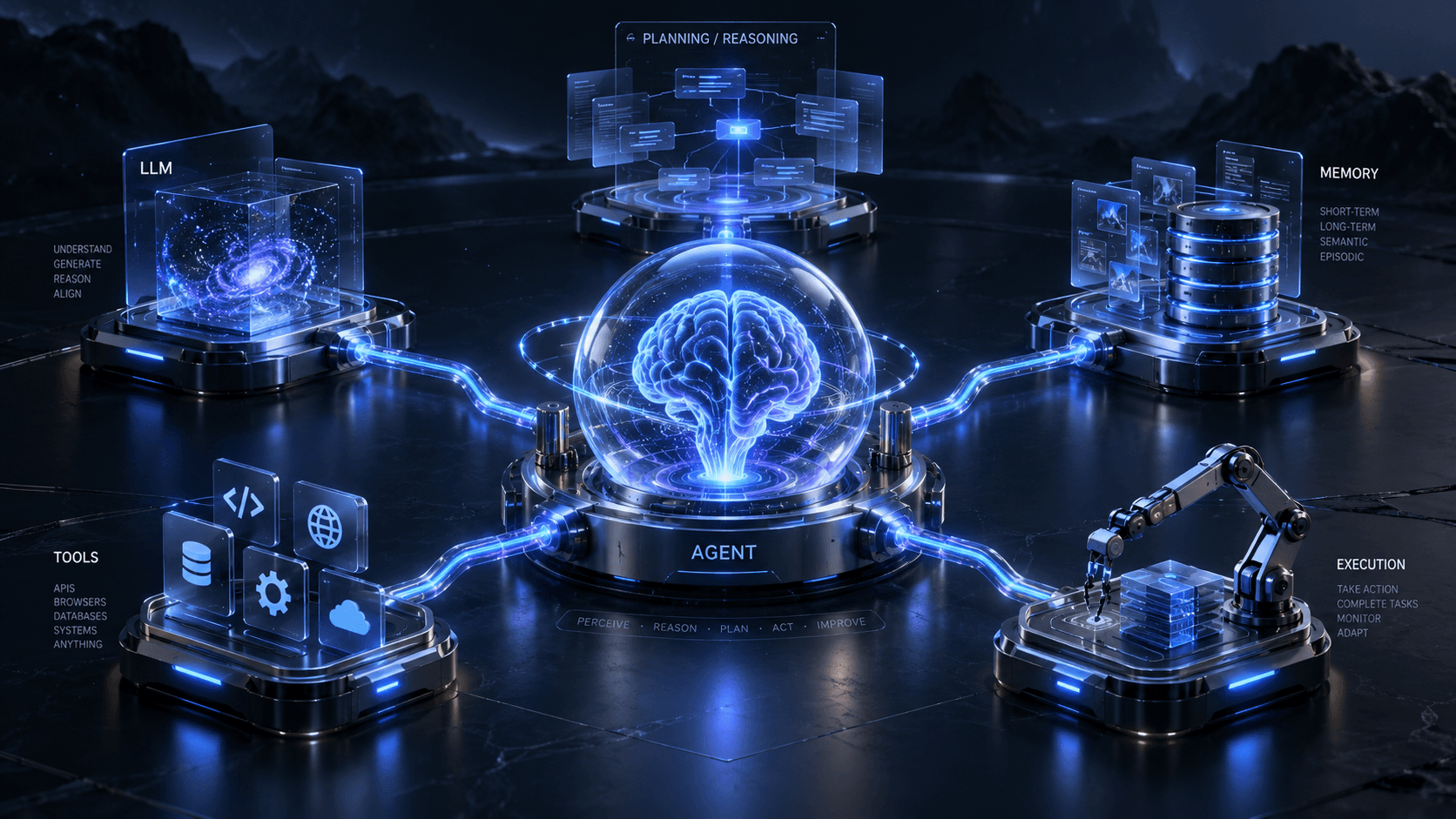
AI Agents represent a shift from simple conversational systems to goal-oriented software. A modern Agent combines LLM reasoning, planning, memory, tools, and evaluation loops to solve complex tasks.
Core Components
flowchart TD
U[User Goal] --> A[AI Agent]
A --> L[LLM]
A --> P[Planning]
A --> M[Memory]
A --> T[Tools]
T --> R[Observation]
R --> A
An LLM provides reasoning capability, but the surrounding architecture determines whether an Agent can operate reliably in real environments.
Planning and Reasoning
Planning allows an Agent to transform a large objective into smaller executable steps. A research assistant may collect sources, validate information, summarize findings, and produce a report through multiple iterations.
This differs from traditional chatbots because the system maintains state and evaluates progress before continuing.
Memory and Context
Memory enables Agents to maintain information over time. Short-term memory handles the current task while long-term memory stores reusable knowledge.
For example, an enterprise assistant can remember reporting preferences and workflows instead of requiring users to repeat instructions.
Tools and External Actions
Tools connect Agents with databases, APIs, files, and execution environments. This capability transforms an Agent from a text generator into an action system.
A customer support Agent can retrieve CRM data, check order status, and create responses automatically.
Agent Loop
flowchart LR
O[Observe] --> R[Reason]
R --> P[Plan]
P --> A[Act]
A --> E[Evaluate]
E --> O
The loop allows continuous improvement through observation and evaluation.
Mini Case Study
An e-commerce company builds an Agent to analyze customer feedback. The LLM understands reviews, memory stores historical trends, tools access sales data, and planning modules generate analysis workflows. The result is faster operational decisions and less manual reporting.
Architecture Best Practices
Developers should separate Agent components so each part can be tested independently. Business logic should not be hidden entirely inside prompts because this creates maintenance problems.
Security boundaries are also important. Tools should have controlled permissions and clear validation rules.
A strong architecture balances autonomy with control. The best Agents are not only intelligent; they are observable, maintainable, and predictable.
Sources
- Anthropic - Building effective agents
- OpenAI - Agents documentation
- Model Context Protocol documentation
Practical Implementation View
In enterprise environments, Agent architecture is often designed as an orchestration layer above existing services. Instead of replacing legacy systems, Agents connect with current infrastructure and provide a more natural way to access information.
For example, a finance Agent can receive an analysis request, retrieve accounting data, perform calculations, and generate explanations. Each step can be controlled instead of giving unlimited authority to the model.
State management is another critical factor. Long-running tasks require Agents to remember progress and recover after interruptions. This is why workflow engines and state handling become important parts of modern Agent systems.
Future Agent Architectures
Future systems may include multiple specialized Agents working together. A planning Agent can delegate tasks to research Agents or validation Agents.
However, adding more Agents does not automatically improve results. Good design requires clear responsibilities, fewer unnecessary actions, and strong control mechanisms.
Practical Implementation View
In enterprise environments, Agent architecture is often designed as an orchestration layer above existing services. Instead of replacing legacy systems, Agents connect with current infrastructure and provide a more natural way to access information.
For example, a finance Agent can receive an analysis request, retrieve accounting data, perform calculations, and generate explanations. Each step can be controlled instead of giving unlimited authority to the model.
State management is another critical factor. Long-running tasks require Agents to remember progress and recover after interruptions. This is why workflow engines and state handling become important parts of modern Agent systems.
Future Agent Architectures
Future systems may include multiple specialized Agents working together. A planning Agent can delegate tasks to research Agents or validation Agents.
However, adding more Agents does not automatically improve results. Good design requires clear responsibilities, fewer unnecessary actions, and strong control mechanisms.
Practical Implementation View
In enterprise environments, Agent architecture is often designed as an orchestration layer above existing services. Instead of replacing legacy systems, Agents connect with current infrastructure and provide a more natural way to access information.
For example, a finance Agent can receive an analysis request, retrieve accounting data, perform calculations, and generate explanations. Each step can be controlled instead of giving unlimited authority to the model.
State management is another critical factor. Long-running tasks require Agents to remember progress and recover after interruptions. This is why workflow engines and state handling become important parts of modern Agent systems.
Future Agent Architectures
Future systems may include multiple specialized Agents working together. A planning Agent can delegate tasks to research Agents or validation Agents.
However, adding more Agents does not automatically improve results. Good design requires clear responsibilities, fewer unnecessary actions, and strong control mechanisms.